SPECIES INFO
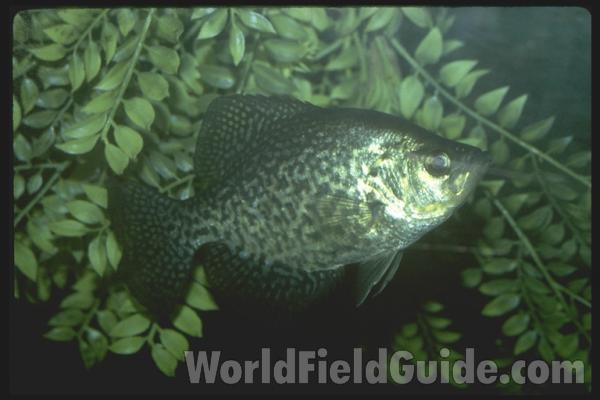
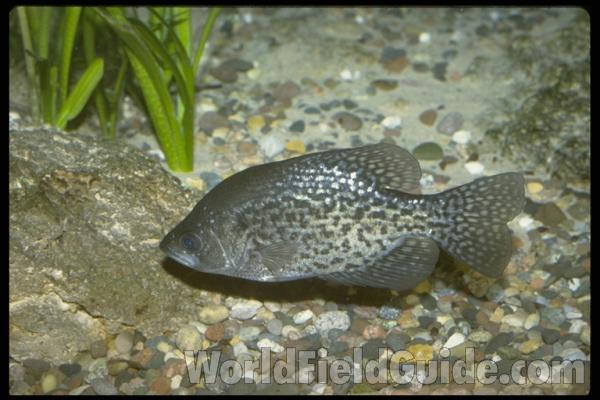
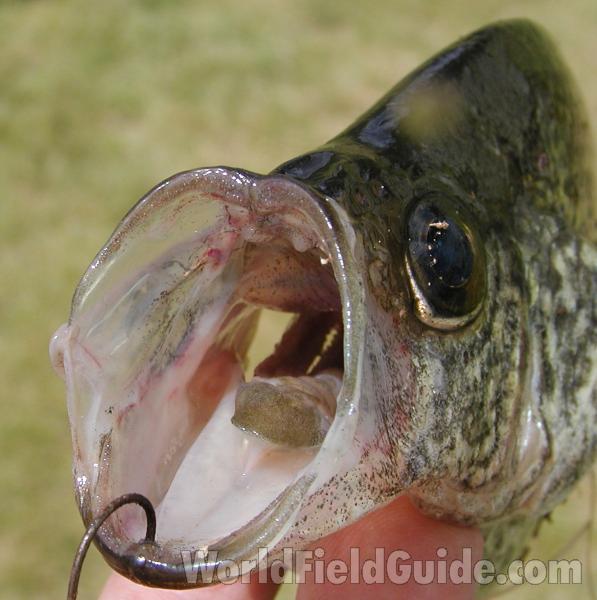
Black Crappie (Pomoxis nigromaculatus) was originally found from New York to the Dakotas and south into Texas and Florida. This species has been widely introduced. This is a very popular sport fish and can be up to 19 inches in length.
Rohde etal in their book on freshwater fishes of the Carolina-Virginia area note this species is native to their area, and this has also been widely stocked. They state it is usually common.
Pflieger in his 1975 book on Missouri fishes notes the black crappie is found sporadically state wide.
The Siglers in their book on Utah fishes note that introduced black crappie populations are fairly abundant in the lowland waters of southern Utah.Pomoxis genus, Crappie, contains only two species. This genus originated east of the Rocky Mountains in North America. However, it has been widely introduced as it is a popular sport fish.
Sunfish and Bass group, Family Centrarchidae, is a group of fish that naturally inhabited North America. Because of their great popularity as a sport fish group, many of the species have
been introduced worldwide with varying degrees of success. There are about 30 species in this family. The crappies, bluegill, and black bass belong here.
Perch-like Fish, Order Perciformes, are the largest order of fish in both freshwater and shallow saltwater. Most of the conventional fish belong to this order. The bass, bluegills, perch and crappies of freshwater plus the groupers and sea bass of salt water belong to this order. The fish all have spiny rays in their fins and the tail fin has seventeen rays. There are approximately 150 families. Herein, we have placed the families in alphabetical sequence within this order. (In some instances the typical taxonomic sequence of families is not much help. Consider, for example, that the barracudas are usually placed between the mullets and the threadfins.)
Bony fish, Class Teleostomi, are a class of chordates that include the majority of fish-like animals found on earth. They are characterized by a bony jaw and a bony skeleton. They are found in both fresh and marine waters.
Backboned Animals (Phylum Chordata) are the most advanced group of animals on earth. These animals are characterized by having a spinal cord or backbone. Most members have a clearly defined brain that controls the organism through a spinal cord. Fish, amphibians, reptiles, birds, and mammals are in this phylum.
Currently, some taxonomists believe that the fish should be divided into two groups (sharks and regular fishes) and that there are some other primitive groups in the phylum such as hagfish or lampreys.
Animal Kingdom contains numerous organisms that feed on other animals or plants. Included in the animal kingdom are the lower marine invertebrates such as sponges and corals, the jointed legged animals such as insects and spiders, and the backboned animals such as fish, amphibians, reptiles, birds, and mammals.