SPECIES INFO
Greater Flameback Woodpecker (Chrysocolaptes lucidus) is found from the Himalayan Mountain Range south through India (race guttacristatus) to Sri Lanka (Ceylon, race stricklandi with unique reddish wings and upper back.) This woodpecker is also found east into south western China and south through the Philippines to the Greater Sundas in Indonesia. This is also found south to Malaysia, Borneo, Sumatra, Java, and Bali. This 10 inch woodpecker has a white breast marked with black lines. The crest is red in the male and dark in the female. The lower back is red. The dorsal wings and back are brownish and the tail is black.
There are 15 recognized subspecies per Howard and Moore in 2003. The nominate subspecies, Chrysocolaptes lucidus lucidus, was discovered on Mindanao in the Philippines and described in 1786. The subspecies sultaneus is found in the northwestern Himalayas. The subspecies guttacristatus is found from the eastern Himalayan region east to Yunnan, China and south into southeastern India, Burma, Thailand and much of southern Indochina. The subspecies socialis is found in southwestern India. The subspecies stricklandi is found in Sri Lanka (Ceylon).
The subspecies indomalayicus is found in Malaysia, Sumatra, and Java. The subspecies andrewsi is found in Borneo. The subspecies kangeanensis is found on Kangean Island. (Kangean is an island located just to the north of eastern Java and Bali.)
The remaining 7 subspecies are found in the Philippines. The subspecies erythrocephalus is found on Palawan and nearby islands. The subspecies haematribon is found on Luzon and Marinduque and nearby islands. The subspecies grandis is found on Polilo Isle. The subspecies rufopunctatus is found on Samar, Leyte, and Bohol. The subspecies montanus is found on Mindanao, and as mentioned above, the nominate subspecies is also found on Mindanao. The subspecies xanthocephalus is found on Panay, Negros, and nearby islands.
Clements in 2007 has combined the NW Himalayan sultanus into guttacristatus. He has renamed indomalayicus as chersonesus. He has eliminated the Philippine grandis by moving that into haematribon.
The Indian subspecies males have a red crest and brownish dorsal wings. The Indian subspecies females have a black and white crest. The Sri Lanka (Ceylon) male forms have a red crest with red dorsal wings. The Chinese version has a black and white breast with a red crest and brownish dorsal wings. The Philippine races have males with red crests. The Philippine males can have reddish or brownish dorsal wings. The Philippine male subspecies generally have a dark upper breast marked with paler spots.
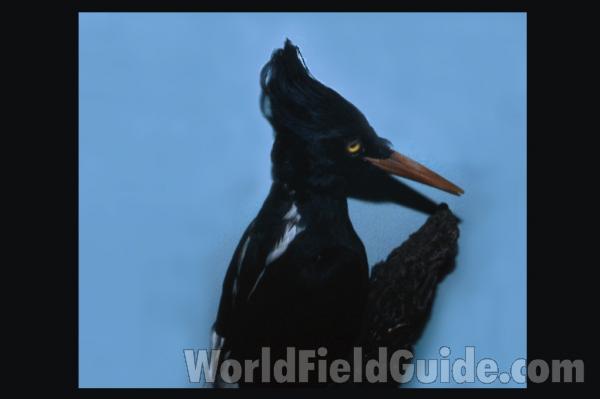
Gorman in 2014 has adopted a very different approach to the taxonomy of this group. He has moved many of the previous subspecies of this group to full species status. We are not sure of the nomenclature of the attached image. However, we are going to follow Gorman's outline herein.
The new limited Chrysocolaptes lucidus is native to the central and southern Philippines. The nominate form is found in the southern Philippines on western Mindanao and nearby islands. The subspecies rufopunctatus is found on Leyte and adjacent small islands. The subspecies montanus is found on central and eastern Mindanao.The Chrysocolaptes genus contains two species of nicely colored woodpeckers. The genus is found from the Himalayas south through India to Sri Lanka. The genus is also found from the Himalayas east to western China and south to SE Asia, Malaysia, Sumatra, Java, and the Philippines.
This genus has recently been divided into about 7 species.
With about 216 species of woodpeckers known, we have arbitrarily divided this family into five geographic sections to help facilitate study of this group.
Woodpeckers (Family Picidae) are a family of over 200 species including the familiar woodpecker and some other primitive birds. Most of the species in this family are adapted to searching for food in the wood of trees.
Monroe and Sibley have increased the count to 216 species as of 1993. Howard and Moore in 2003 counted 210 species. Gorman in 2014 counted 239 species.
Several species are quite large and several are almost tiny. The great slaty woodpecker of the Indo-Australian region can reach over 20 inches in length. The extinct ivory billed woodpecker of North America was also about 20 inches in length. The white browed piculet of the China- SE Asian region is less than 4 inches in length.
We have divided the Picidae into 5 major groups. We provided one for each of the five major geographical regions. However, we created an additional 4 special groups following four of the major groups, as we felt the Wrynecks and Piculet groups should be separated out.
Woodpeckers and Toucans (Order Piciformes) are separated from most other birds by an unusual tendon and foot arrangement that includes two forward and two rear pointing toes. There are six families in this order. Most species in this order have unusual bills adapted for their unique way of obtaining food.
Some taxonomists place the puffbirds and jacamars in various places in the taxonomy tree. We have included the puffbirds (Bucconidae) and jacamars (Galbulidae) herein.
Aves contains about 8,650 different species of living birds known to science. Each year about one new species is discovered in some remote rain forest or remote island. In addition, scientists have been raising many subspecies to full species status which may raise the species count to 10,000. Birdlife recognizes 10,027 species as of 2011.
However, each year about one species goes extinct. The rate of extinction is increasing, and the rate of new discovery is decreasing, so that the number of bird species will soon begin to decline rapidly. Although different taxonomists would organize the birds differently, there are approximately twenty-seven orders of birds. These orders are broken down into about one hundred and fifty-five different families.
Recent research of the genetic structure of some of the shore birds and owls would indicate that the present organization of orders and families should have some modification.
The birds are a worldwide group of animals that are characterized by having the front limbs modified into wings that are used for flying. Perhaps the most unique feature of the birds is the feathers. These feathers are made up of a central support called a quill and a series of small filaments that are hooked together as barbs.
For many years it was believed that Archaeopteryx discovered in Bavaria was the oldest bird from about 150 million years ago. However, in l986, Sankar Chattterjee, a Texas paleontologist, reportedly discovered a bird in the genus Protoavis that lived about 225 million years ago.
When this project was begun in 1978, we used Austin & Singer for bird taxonomy. Since then, we have adopted many changes, but have kept some older concepts that are still found widely in the literature. Recently, we have used Clements and Howard & Moore. Very recently, we have used Monroe and Sibley for the higher taxonomy of the perching birds.
Backboned Animals (Phylum Chordata) are the most advanced group of animals on earth. These animals are characterized by having a spinal cord or backbone. Most members have a clearly defined brain that controls the organism through a spinal cord. Fish, amphibians, reptiles, birds, and mammals are in this phylum.
Currently, some taxonomists believe that the fish should be divided into two groups (sharks and regular fishes) and that there are some other primitive groups in the phylum such as hagfish or lampreys.
Animal Kingdom contains numerous organisms that feed on other animals or plants. Included in the animal kingdom are the lower marine invertebrates such as sponges and corals, the jointed legged animals such as insects and spiders, and the backboned animals such as fish, amphibians, reptiles, birds, and mammals.