SPECIES INFO
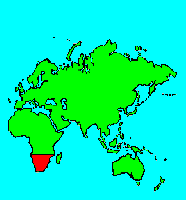
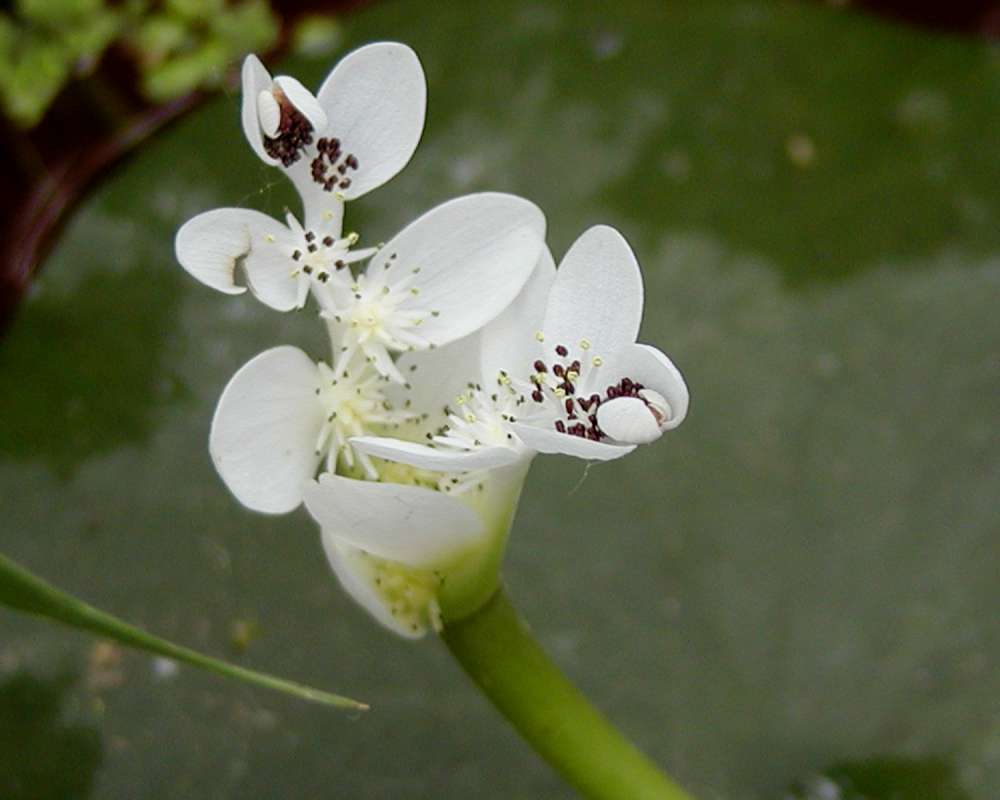
Water hawthorn or cape pondweed (Aponogeton distachyos) is a native of South Africa. This popular ornamental is spreading into a larger range including North America.Aponogeton genus is a widespread Old World genus found from Africa east through Madagascar to the warm areas of Asia all the way to Australia. There are about forty species in the genus. Although the leaves of these plants usually float, some leaves can be completely submerged. The leaves are typically oblong. However, the Madagascar lace plant has unusual submerged leaves. One species is now considered established in greater North America.
The Aponogeton family (Family Aponogetonaceae) is native to the Old World tropics and subtropics. This family naturally occurs in tropical areas from Africa east to southern Asia and south to northern Australia. This family contains over 40-50 species of aquatic freshwater perennials with long petioled mostly basal leaves. These leaves can be submerged or floating. The flowers are in spikes.
Order Helobiae is a mixed assemblage of mostly aquatic plant families. Included here are the pondweeds, Najas, frog's-bit, eel-grass, and water plantains (Sagittaria). This is an arbitrary collection of families used primarily to reduce the number of orders. Some species are totally submerged while others live in shallow water with leaves and flowers above the water line. Some species have both submerged and floating leaves.
Monocots are a large group of plants usually characterized by having leaves with parallel veins and a seed with a single shell. Most flowers are created with multiples of three. In the older botany texts, the Monocots were considered more primitive than the Dicots. However, many recent authors have placed the Monocots as an offshoot of the primitive Dicots. Here they are placed before the Dicots.
In l951 Lawrence at Cornell published a very detailed plant taxonomy for vascular plants. His taxonomy is very useful as he provided both a detailed explanation and also covered many genera. In the l990s Cronquist published a new plant taxonomy that improved the older taxonomy based on new knowledge. About the same time, Dahlgren published a different taxonomy.
Seed plants (Phylum Embryophyta) are generally grouped into one large phylum containing three major classes: the Gymnosperms, the Monocots, and the Dicots. (Some scientists separate the Gymnosperms into a separate phylum and refer to the remaining plants as flowering plants or Angiospermae.)
For North American counts of the number of species in each genus and family, the primary reference has been John T. Kartesz, author of A Synonymized Checklist of the Vascular Flora of the United States, Canada, and Greenland (1994). The geographical scope of his lists include, as part of greater North America, Hawaii, Alaska, Greenland, Puerto Rico, and the Virgin Islands.
Kartesz lists 21,757 species of vascular plants comprising the ferns, gymnosperms and flowering plants as being found in greater North America (including Alaska, Hawaii, Greenland, Puerto Rico and the Virgin Islands.
There are estimates within the scientific world that about half of the listed North American seed plants were originally native with the balance being comprised of Eurasian and tropical plants that have become established.
Plant kingdom contains a large variety of different organisms including mosses, ferns, and seed plants. Most plants manufacture their energy from sunlight and water. Identification of many species is difficult in that most individual plants have characteristics that have variables based on soil moisture, soil chemistry, and sunlight.
Because of the difficulty in learning and identifying different plant groups, specialists have emerged that study only a limited group of plants. These specialists revise the taxonomy and give us detailed descriptions and ranges of the various species. Their results are published in technical journals and written with highly specialized words that apply to a specific group.
On the other hand, there are the nature publishers. These people and companies undertake the challenging task of trying to provide easy to use pictures and descriptions to identify those species.