SPECIES INFO
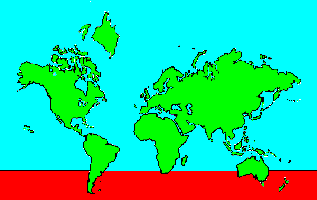
Wandering albatross (Diomedea exulans) is found circumpolar in the southern oceans of the world. In Australia it can only be seen in the oceans off the southern coast. This albatross is known to breed in the New Zealand area. This also breeds circumpolar in suitable southern sites. This albatross generally stays south of the southern tip of South America. However, it can sometimes be seen in both oceans near the southern tip of South America.
This bird is from 32 to about 52 inches in length. However, the wingspan can be up to 140 inches or near 10-12 feet. The young are brown with a white face, and the adults are white with a black back. When flying the underside of the wings show white. However, the wing tip is always dark. The dorsal side of the wings when flying can be brown or white marked with brown along the trailing edge. This species appears to be the largest bird capable of flight.
Howard and Moore in 2003 have made this the nominate subspecies of D. exulans. There are four other subspecies.
Birdwatch in 2011 listed this as vulnerable and also decreasing. They estimated only about 26,000 individuals remain.
Birdwatch also listed the Tristan albatross (Diomedea dabbenena) as critically endangered. However, the Howard and Moore checklist of 2003 placed D. dabbenena as a synonym of Diomedea exulans exulans.
The taxonomy as presented by Howard-Moore in 2003 listed the following subspecies:
Diomedea exulans exulans - migrating to the southern Atlantic
Diomedea exulans chionoptera - migrating to southern Oceans
Diomedea exulans amsterdamensis - migrating to southern ocean
Diomedea exulans antipodensis - migrating to southern Pacific Ocean
Diomedea exulans gibsoni - migrating to the SW Pacific Ocean
In conflict with the above list in the birds of Melanesia they note that the nominate subspecies has been rarely recorded.Albatross genus (Diomedea) contains about 12 species of birds. These are all generally found in the southern oceans generally south of the Equator. One species (Diomedea albatrus) used to be found in the northern Pacific, but it is no longer found there. Another species (Diomedea nigripes) is still found in the northern Pacific Ocean. These are generally birds with long narrow wings of a great span, frequently over 6 or 7 feet.
This genus has been recently divided. Only two species remain, but also one subspecies has been raised to full species status, thus three (3) species are here.
Four (4) species have ben moved to the Phoebastria genus.
Five (5) species have been moved to the Thalassarche genus.
Albatross Family (Diomedeidae) contains about thirteen or fourteen species of large-bodied birds with long pointed wings.
Most Albatrosses are excellent gliders, but not such excellent fliers. Albatrosses need various wind currents to help them stay aloft, and consequently, they are most numerous in the windy oceans of the world.
The largest Albatross, the Wandering Albatross (Diomedea exulans) has a wing span of ten to eleven feet. This species breeds in the South Pacific. Young take to the wing, and fly and glide for about seven years before returning to their island origins to breed.
Fishermen, in the search for Bluefin Tuna, string out long lines behind their boats with hundreds of hooks and pieces of squid. The squid, one of the natural foods for the albatross attracts the birds, and they kill themselves in attempting to feed on the squid. It is felt that this practice could be killing up to 44,000 Wandering Albatross per year.
Amsterdam Albatross (Diomedea amsterdamensis) breeds only on the Amsterdam Island in the Indian Ocean. In l985, it was observed that only about five pairs of this species were breeding per year.
Short Tail Albatross (Diomedea albanus) breeds only on Torishima, a volcanic island south of Japan. Feather hunting and volcanic eruptions almost brought this species to extinction. In 1986, the population on Torishima was estimated at 146 adults and 77 young.
Tube Nosed Swimmers (Order Procellariiformes) contains three families of primarily marine birds. There are about 114 different species in this order. The albatrosses, shearwaters, storm petrels, and diving petrels are contained in this order.
Aves contains about 8,650 different species of living birds known to science. Each year about one new species is discovered in some remote rain forest or remote island. In addition, scientists have been raising many subspecies to full species status which may raise the species count to 10,000. Birdlife recognizes 10,027 species as of 2011.
However, each year about one species goes extinct. The rate of extinction is increasing, and the rate of new discovery is decreasing, so that the number of bird species will soon begin to decline rapidly. Although different taxonomists would organize the birds differently, there are approximately twenty-seven orders of birds. These orders are broken down into about one hundred and fifty-five different families.
Recent research of the genetic structure of some of the shore birds and owls would indicate that the present organization of orders and families should have some modification.
The birds are a worldwide group of animals that are characterized by having the front limbs modified into wings that are used for flying. Perhaps the most unique feature of the birds is the feathers. These feathers are made up of a central support called a quill and a series of small filaments that are hooked together as barbs.
For many years it was believed that Archaeopteryx discovered in Bavaria was the oldest bird from about 150 million years ago. However, in l986, Sankar Chattterjee, a Texas paleontologist, reportedly discovered a bird in the genus Protoavis that lived about 225 million years ago.
When this project was begun in 1978, we used Austin & Singer for bird taxonomy. Since then, we have adopted many changes, but have kept some older concepts that are still found widely in the literature. Recently, we have used Clements and Howard & Moore. Very recently, we have used Monroe and Sibley for the higher taxonomy of the perching birds.
Backboned Animals (Phylum Chordata) are the most advanced group of animals on earth. These animals are characterized by having a spinal cord or backbone. Most members have a clearly defined brain that controls the organism through a spinal cord. Fish, amphibians, reptiles, birds, and mammals are in this phylum.
Currently, some taxonomists believe that the fish should be divided into two groups (sharks and regular fishes) and that there are some other primitive groups in the phylum such as hagfish or lampreys.
Animal Kingdom contains numerous organisms that feed on other animals or plants. Included in the animal kingdom are the lower marine invertebrates such as sponges and corals, the jointed legged animals such as insects and spiders, and the backboned animals such as fish, amphibians, reptiles, birds, and mammals.