SPECIES INFO
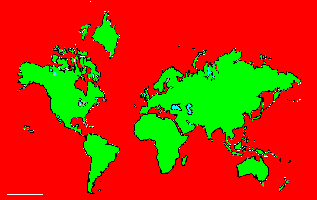
Piked dogfish shark or spiny dogfish (Squalus acanthias) is found almost worldwide in temperate oceans, but this species appears absent in the tropical oceans. In the western Pacific Ocean it is found near China and north to Siberia. It is also found near southern Australia and Tasmania. In the eastern Pacific Ocean it is found from Alaska south to northern Mexico, and from Peru south to the southern tip of South America. In the western Atlantic Ocean it is found from Canada to Florida, and also off Argentina. In the eastern Atlantic it is found widely in the European and Mediiterranean areas. In the eastern Atlantic it is found off southern Africa. In the Indian Ocean it has been taken in southern Africa.
This is the largest member of the family, and it can reach about 80 inches in length. Both dorsal fins are nearly identical each with a leading spine. Younger individuals of this brown shark are marked with small white spots.
There is an excellent drawing on page 15 of the Diamond handbook on fishes of Britain and Europe by Nichols and Miller. This shark was once very common, but it is a slow grower and consequently does not replenish itself quickly. In many areas this is now threatened or endangered.Dogfish sharks (Family Squalidae) are represented in all the oceans of the world. However, most species have limited distributions. There are at least 16 species in this family, and as of 2005 at least 6 of them were awaiting identification. There are two widely separated dorsal fins. The dorsal fins usually have a prominent leading spine. Most species are from 18 inches to 36 inches in length. However, one species (Squalis acanthias) can attain a length of about 6 feet.
The dogfish shark order (Squaliformes) contains 7 different families. The famlies and their species count estimates are as follows:
Echinorhinidae - Bramble sharks - 2 species
Squalidae - Dogfish sharks - 16 species
Centrophoridae - Gulper sharks - 14 species
Etmopteridae - Lantern sharks - 41 species
Somniosidae - Sleeper sharks - 18 species
Oxynotidae - Rough sharks - 5 soecues
Dalatiidae - Kitefin sharks - 10 species
Sharks and rays (Elasmobranchi), cartilaginous fishes, deserve to be a class separate from the normal fish, in that they do not have a bone skeleton but rather a cartilage skeleton.
Fertilization is internal in this class which also separates them from the bony fish class. Although there are a few fresh water species, the majority of the species in this class are found in salt water. As of 2005, there were about 500 known species of sharks and about 600 known species of rays.
David Ebert, author of a recent book on sharks, rays, and chimaeras of California, counts a total of 988 described species in the class with about 150 additional species awaiting scientific description. He breaks down the described species to 410 species of sharks, 543 species of rays, and 35 species of chimaeras.
Many species of sharks face an uncertain future, as the Chinese purchase shark fins to make shark fin soup. It was estimated that 100 milllion sharks are killed each year for this purpose. However, recent estimates indicate the Chinese are reducing their consumption of this exotic soup.
Backboned Animals (Phylum Chordata) are the most advanced group of animals on earth. These animals are characterized by having a spinal cord or backbone. Most members have a clearly defined brain that controls the organism through a spinal cord. Fish, amphibians, reptiles, birds, and mammals are in this phylum.
Currently, some taxonomists believe that the fish should be divided into two groups (sharks and regular fishes) and that there are some other primitive groups in the phylum such as hagfish or lampreys.
Animal Kingdom contains numerous organisms that feed on other animals or plants. Included in the animal kingdom are the lower marine invertebrates such as sponges and corals, the jointed legged animals such as insects and spiders, and the backboned animals such as fish, amphibians, reptiles, birds, and mammals.