SPECIES INFO
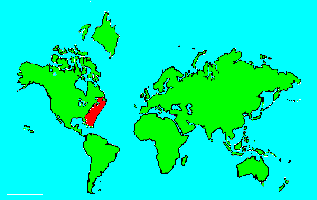
Snook (Centropomus undecimalis) is found from Florida to Brazil. Although this is a marine fish, it can navigate up fresh water rivers. This species used to be present in giant schools. The snook can be up to 4 feet long and weigh up to 50 pounds. Most specimens are much smaller. The snook has a dark lateral line, and a lower jaw that protrudes beyond the upper jaw. The two dorsal fins, pelvic fin, and anal fin are about the same size. This species breeds in mangrove roots, and development of shorelines is taking away their breeding grounds. This species has some protection from commercial fisheries, and in Florida can only be caught by sport fishermen.Snooks (genus Centropomus) typically breed in coastal mangroves. There might be come confusion in the taxonomy of this genus, as the number of scales along the lateral line might indicate additional species.
The snook family is found primarily in warmer oceans. Some species are found in freshwater in Africa. Members of this family are called snooks or robalo. This is a small family.
Perch-like Fish, Order Perciformes, are the largest order of fish in both freshwater and shallow saltwater. Most of the conventional fish belong to this order. The bass, bluegills, perch and crappies of freshwater plus the groupers and sea bass of salt water belong to this order. The fish all have spiny rays in their fins and the tail fin has seventeen rays. There are approximately 150 families. Herein, we have placed the families in alphabetical sequence within this order. (In some instances the typical taxonomic sequence of families is not much help. Consider, for example, that the barracudas are usually placed between the mullets and the threadfins.)
Bony fish, Class Teleostomi, are a class of chordates that include the majority of fish-like animals found on earth. They are characterized by a bony jaw and a bony skeleton. They are found in both fresh and marine waters.
Backboned Animals (Phylum Chordata) are the most advanced group of animals on earth. These animals are characterized by having a spinal cord or backbone. Most members have a clearly defined brain that controls the organism through a spinal cord. Fish, amphibians, reptiles, birds, and mammals are in this phylum.
Currently, some taxonomists believe that the fish should be divided into two groups (sharks and regular fishes) and that there are some other primitive groups in the phylum such as hagfish or lampreys.
Animal Kingdom contains numerous organisms that feed on other animals or plants. Included in the animal kingdom are the lower marine invertebrates such as sponges and corals, the jointed legged animals such as insects and spiders, and the backboned animals such as fish, amphibians, reptiles, birds, and mammals.