SPECIES INFO
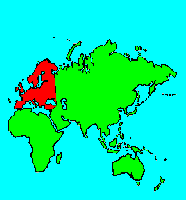
Ziege (Pelecus cultratus) is found from Poland and the Baltic Countries, and then in a second area north of the Black Sea to north of the Caspian Sea. There is also a population near the Aral Sea. This fish is generally from 8 to 12 inches in length. However, large examples from 20 to 24 inches are known. The mouth generally points upwards in this species. Although not considered tasty, there is commercial activity for this species in the region of the Black Sea.Carp and minnow family, Cyprinidae, is a group of freshwater fishes that contains the carp, the familiar goldfish, the bream, the minnows, barbs, and many other kinds of fish. This family is found in the Northern Hemisphere and Africa , but is not represented with natural species in either Australia or South America. There are over 1,500 species and probably nearer 2,000 in the family. Many members of this family serve as food and bait fish for larger species. Many are popular aquarium fish. Most species have mostly soft rays in their dorsal fin.
Order Cypriniformes contains the majority of the world's freshwater species of fish. Included in this order are the minnows, carp, and many other groups of fish.
Bony fish, Class Teleostomi, are a class of chordates that include the majority of fish-like animals found on earth. They are characterized by a bony jaw and a bony skeleton. They are found in both fresh and marine waters.
Backboned Animals (Phylum Chordata) are the most advanced group of animals on earth. These animals are characterized by having a spinal cord or backbone. Most members have a clearly defined brain that controls the organism through a spinal cord. Fish, amphibians, reptiles, birds, and mammals are in this phylum.
Currently, some taxonomists believe that the fish should be divided into two groups (sharks and regular fishes) and that there are some other primitive groups in the phylum such as hagfish or lampreys.
Animal Kingdom contains numerous organisms that feed on other animals or plants. Included in the animal kingdom are the lower marine invertebrates such as sponges and corals, the jointed legged animals such as insects and spiders, and the backboned animals such as fish, amphibians, reptiles, birds, and mammals.