SPECIES INFO
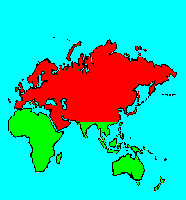
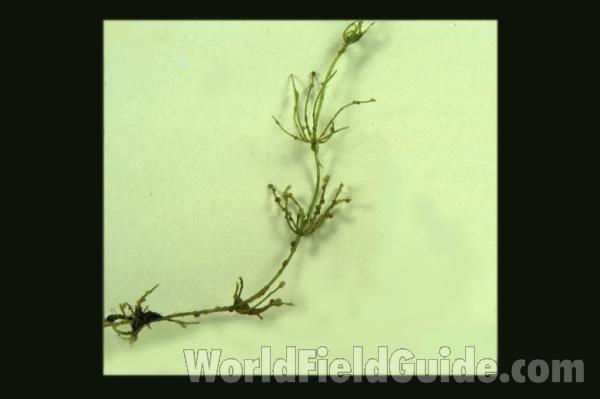
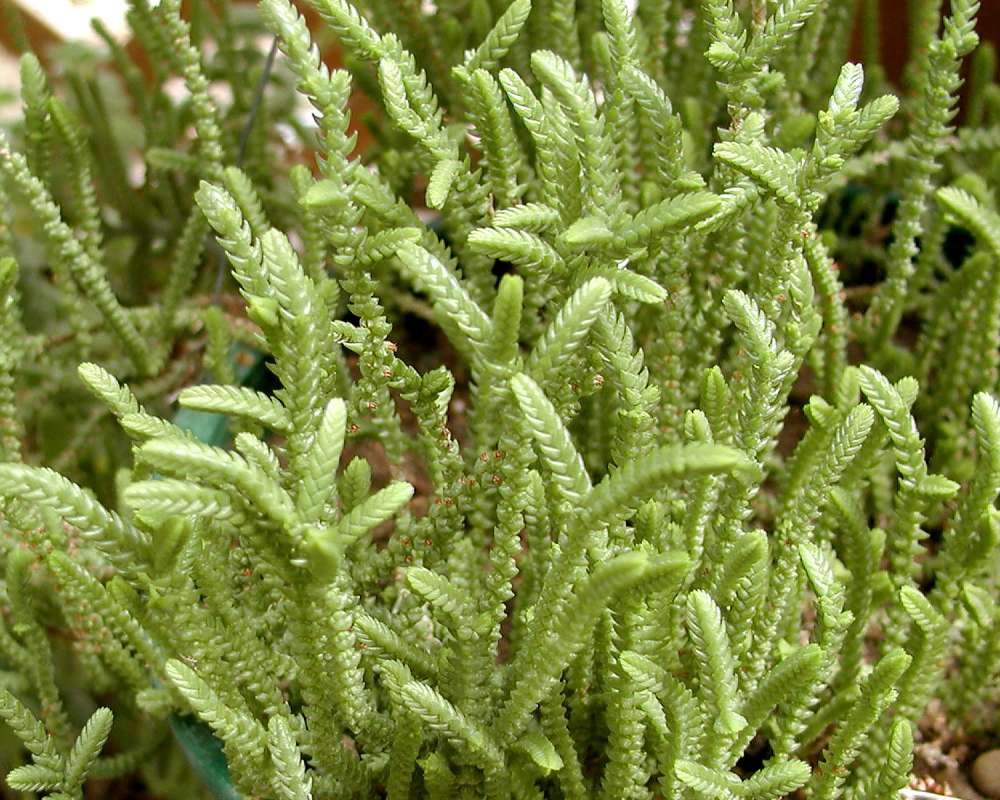
Musk Grass(Chara vulgaris) is found in the Northern Hemisphere worldwide. In the northern United States, this alga frequently forms large mats or carpets on the bottoms of clear spring-fed fresh water lakes. These mats are sometimes up to one foot thick, and serve as homes for many bottom-feeding fish and animals. This algae can be easily recognized from a boat or from the shore as it has a distinctive yellow-green color.
This algae frequently becomes encrusted with lime. However, when Carp become too plentiful in a lake, this species becomes rare. The presence of this species helps keep water clear. On windy days, when wave action is present, this alga acts as a buffer between currents and silty bottoms.Musk Grasses (Family Characeae) are a family of various algae that can become quite common in freshwater lakes.
Stoneworts (Charophyceae) is a subgroup of the Green Algae. The Stoneworts have about 250 species.
Green Algae Group (Chlorophyta) is usually broken into three main categories: Charophyceae, typical Chlorophyceae, and Euglenophyceae. The Euglenophyceae can also be placed as a separate group in that they contain animal-like features. They are placed here in a separate class as opposed to making them one of the three subgroups of green algae.
Protista kingdom (sometimes spelled as Protoctista) contains numerous phyla including unicellular animals and algae. Generally, these are aquatic life forms. The number of species is difficult to estimate, and it might be as low as 60,000 and as high as 200,000.
There is discussion among scientists as to whether this group of lifeforms should be split into two different kingdoms. One for those that make their own food, and the other for those that eat food. They suggest: Chromista and Protozoa.
Although herein we follow conventional norms and recognize 9 phyla, it has been suggested there might be 50 different phyla herein. These lifeforms have been found as far back as 1.2 billion years ago.