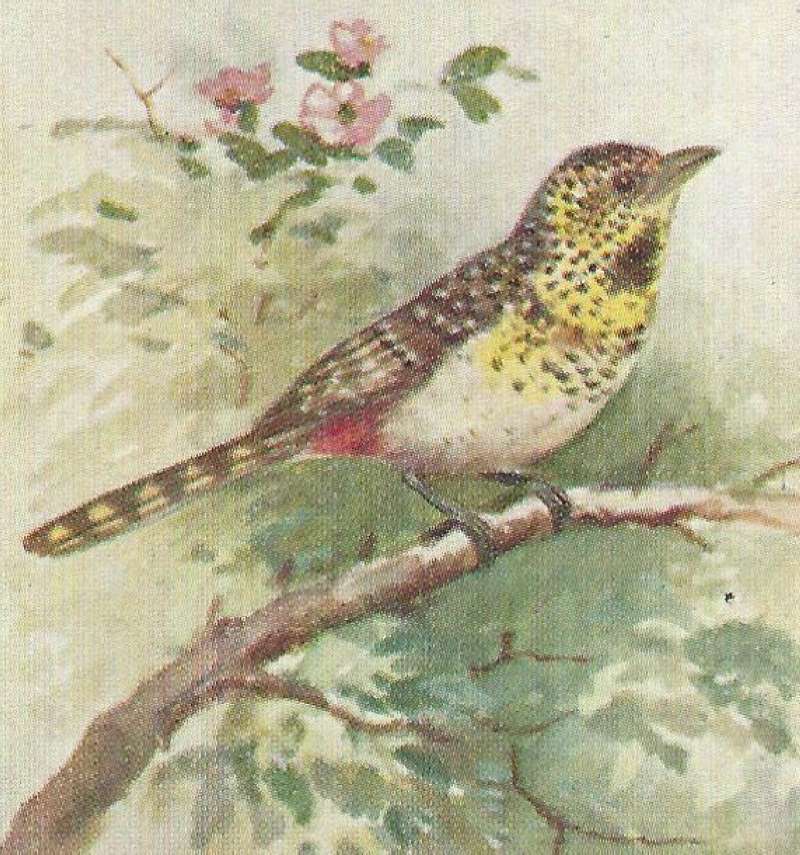
SPECIES INFO
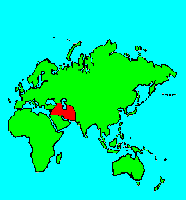
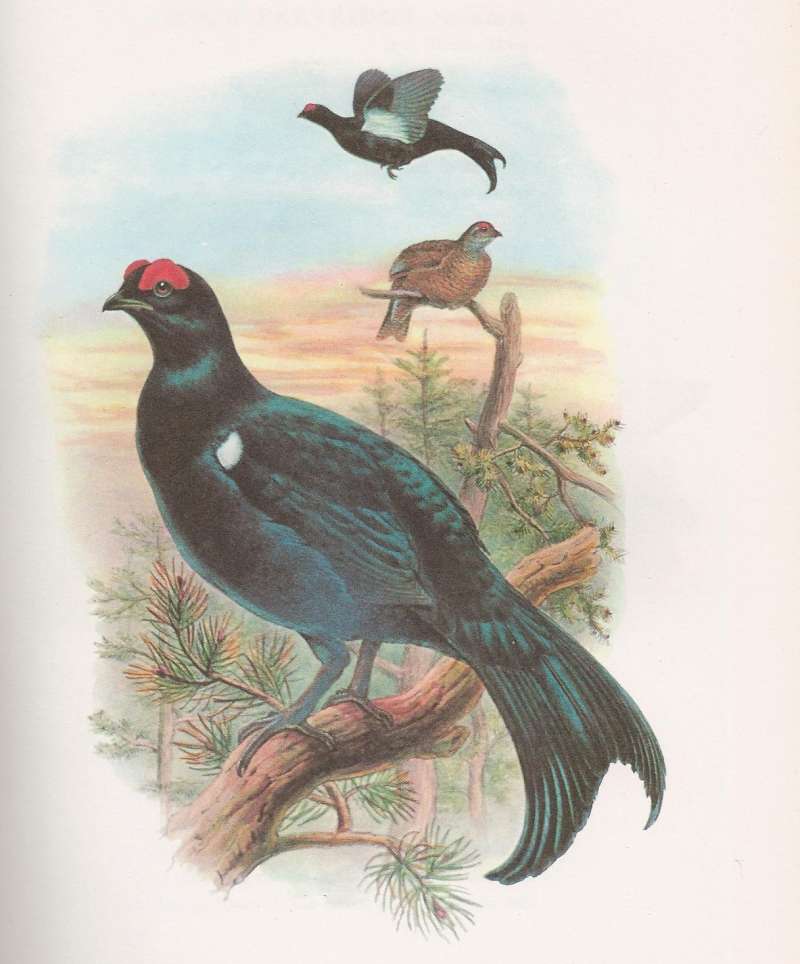
Black bill capercaillie (Tetrao urogalloides to Tetrao parvirostris) is found from Lake Baikal to eastern Siberia in central USSR. This species is close to Tetrao urogallus. However, the male of this species has a black bill, and this species has a darker face and neck. A Field Guide to Birds of the USSR by Flint, Boehme, Kostin, and Kuznetsov states this species can reach 97 cm.
Howard and Moore in 2003 listed two subspecies:
Tetrao parvirostris parvirostris - Siberia and Mongolia and east
Tetrao parvirostris kamschaticus - Kamchatka Peninsula
Clements in 2007 listed three subspecies:
Tetrao parv. parvirostris E. Siberia to Manchuria and Sakhalin Isle
Tetrao parv. kamschaticus - Kamchatka Peninsula
Tetrao parv. stegmanni - Lake Baikal, Sayan Mnts, and N. MongoliaThe grouse or capercaillie genus (Tetrao) contains 4 species. The genus is found only in the temperate and colder areas of the Old World. These are large birds generally from 16 to 24 inches in length. The males are usually dark colored. There is sexual dimorphism and the females are brownish. (In some works, Howard and Moore (2003) for example, two members of this genus are placed in the Lyrurus genus. (Lyrurus tetrix and Lyrurus mlokosiewiczi))
Grouse Family (Family Tetraonidae) contains 17-18 species of birds that are found in both North America and Eurasia. The downward curve of the short bill helps separate the various grouse from the other families in the Galliformes order. The genera Dendragapus(3 + ssp), Lagopus(3), Tetrao(4), Bonasa(3), Centrocercus(1),and Tympanuchus(3) belong here.
Potapov and Sale break the genera into 20 species as follows:
Bonasa(3) (incl Tetrastes): umbellus, bonasia, and sewerzowi
Falcipennis(3):canadensis, franklinii(ssp?), falcipennis
(Falcipennis franklini could be a Ssp of F. canadensis)
Dendragapus(2): obscurus and fuliginosus
Centrocercus(2): urophasianus, minimus (New Species)
Tetrao(2): urogallus and parvirostris
Lagopus(3): lagopus, mutus, and leucurus
Lyrurus(2):(Near Tetrao) tetrix,mlokosiewiczi
Tympanuchus(3): cupido, pallidicintus, and phasianellus
Potapov and Sale note that the main differences separating this family relate to abilities to survive in harsh winter conditions with limited sunlight. Most species have extra snow support in their feet. Pectinated toes and feathered toes are examples.
Fowl group (Galliformes order) contains the various chickens and turkey-like birds of the world. There are about 240 different species of fowl known. Many of the wild species are endangered. Several species such as the domesticated chicken and turkey are main food sources in the world. Most fowl are grain eaters and spend a good portion of their life searching for food on the ground. Select species have been domesticated for their beauty and/or edibility, others are considered good game birds.
Aves contains about 8,650 different species of living birds known to science. Each year about one new species is discovered in some remote rain forest or remote island. In addition, scientists have been raising many subspecies to full species status which may raise the species count to 10,000. Birdlife recognizes 10,027 species as of 2011.
However, each year about one species goes extinct. The rate of extinction is increasing, and the rate of new discovery is decreasing, so that the number of bird species will soon begin to decline rapidly. Although different taxonomists would organize the birds differently, there are approximately twenty-seven orders of birds. These orders are broken down into about one hundred and fifty-five different families.
Recent research of the genetic structure of some of the shore birds and owls would indicate that the present organization of orders and families should have some modification.
The birds are a worldwide group of animals that are characterized by having the front limbs modified into wings that are used for flying. Perhaps the most unique feature of the birds is the feathers. These feathers are made up of a central support called a quill and a series of small filaments that are hooked together as barbs.
For many years it was believed that Archaeopteryx discovered in Bavaria was the oldest bird from about 150 million years ago. However, in l986, Sankar Chattterjee, a Texas paleontologist, reportedly discovered a bird in the genus Protoavis that lived about 225 million years ago.
When this project was begun in 1978, we used Austin & Singer for bird taxonomy. Since then, we have adopted many changes, but have kept some older concepts that are still found widely in the literature. Recently, we have used Clements and Howard & Moore. Very recently, we have used Monroe and Sibley for the higher taxonomy of the perching birds.
Backboned Animals (Phylum Chordata) are the most advanced group of animals on earth. These animals are characterized by having a spinal cord or backbone. Most members have a clearly defined brain that controls the organism through a spinal cord. Fish, amphibians, reptiles, birds, and mammals are in this phylum.
Currently, some taxonomists believe that the fish should be divided into two groups (sharks and regular fishes) and that there are some other primitive groups in the phylum such as hagfish or lampreys.
Animal Kingdom contains numerous organisms that feed on other animals or plants. Included in the animal kingdom are the lower marine invertebrates such as sponges and corals, the jointed legged animals such as insects and spiders, and the backboned animals such as fish, amphibians, reptiles, birds, and mammals.