SPECIES INFO
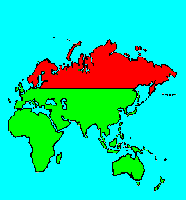
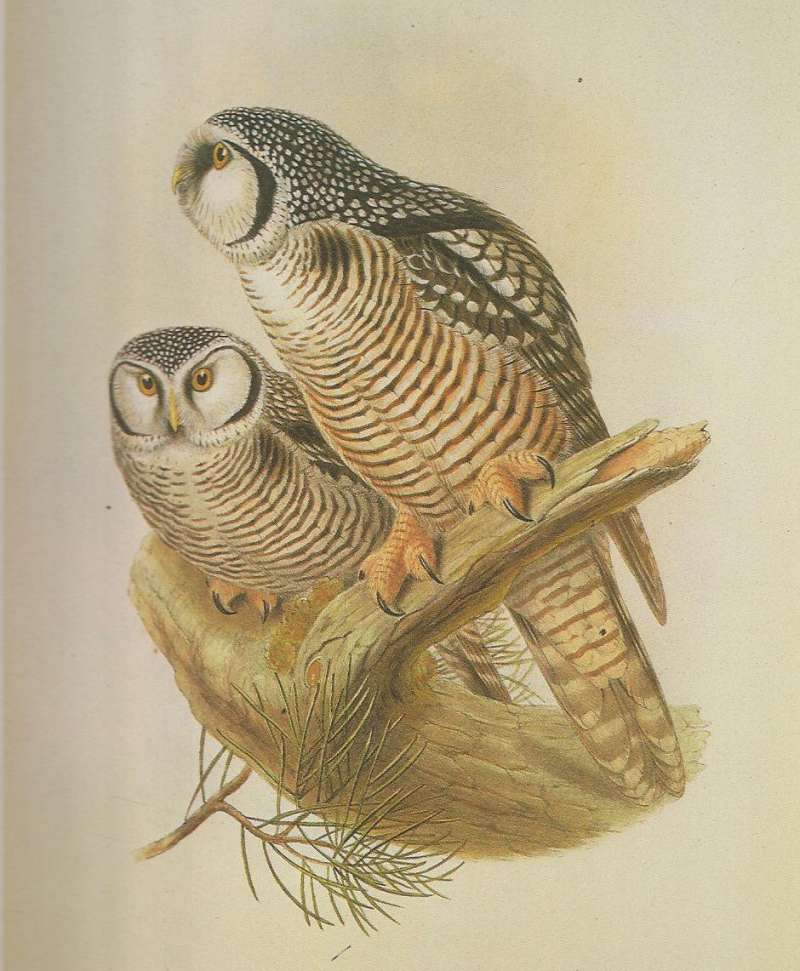
Northern hawk owl (Surnia ulula) is found circumpolar. However, this is not primarily an Arctic species, but a species of the far north. This is found from eastern Canada including Newfoundland and Labrador west through Quebec and further west to central Alaska. In Eurasia this is found from Scandinavia east to Kamchatka near the Bering Sea. This is also found south in Asia to the mountains of central Asia. This 15 to 16 inch plus owl has a very pale breast marked with numerous horizontal dark lines. The face is pale, but there are dark eyebrows and a dark edge to the face. This owl is adapted to feeding in full daylight, and in the summer months with extended hours of weak light, this owl is also active.
There are three subspecies. The nominate subspecies, Surnia ulula ulula is found in northern Eurasia. The ssp caparoch is found from Newfoundland west to Alaska and south into the northern USA. The subspecies tianschanica is found in central Asia including northern China and Mongolia.Hawk owl genus (Surnia) contains a single species that is found in the northern woods of both the New and Old World.
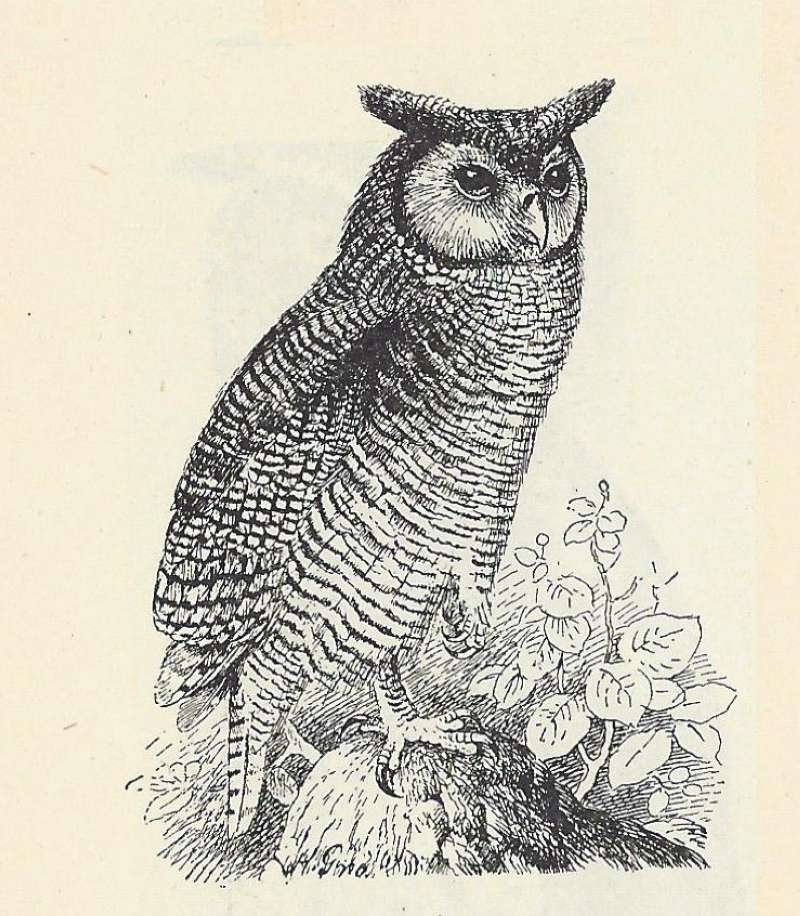
We have arbitrarily separated the medium sized and larger owls into a separate group.
Typical Owls family (Strigidae) contains the majority of owl species. They have round faces and large eyes. Most species fly and feed at night. Since most species hide by day, it is frequently difficult to estimate the rarity of certain species. There are about 160 species in this family.
In order to facilitate study of this group, we have divided this family into three arbitrary groups. The scops and screech owls are generally small and they comprise our fist group. The second group includes the small and tiny owls (Athene and Glaucidium, for example). The third division is the large owls usually over 12-14 inches in length. One motivation for this division is related to the fact that several of the species in the Otus genus can be placed into other genera, and that makes them hard to find in a larger alphabetical list.
Owls (Order Strigiformes) are found worldwide. They are characterized by flexible feathers (for flying quietly), forward facing eyes, hunting at night for live prey, and swallowing their prey whole. There were 133 species of owls in books from about 1960. Clements in 2007 counted 199 based on many subspecies being raised to species status. Most students divide the owls into two families. However, the differences between the barn owls and regular owls is slight, and the Europeans tend to combine them all into a single family.
The outer toe is reversible permitting various methods of holding prey. In the sample claw images, the left set is for barn owls, the center set of claws is fishing owls, and the final set is typical owls.
Aves contains about 8,650 different species of living birds known to science. Each year about one new species is discovered in some remote rain forest or remote island. In addition, scientists have been raising many subspecies to full species status which may raise the species count to 10,000. Birdlife recognizes 10,027 species as of 2011.
However, each year about one species goes extinct. The rate of extinction is increasing, and the rate of new discovery is decreasing, so that the number of bird species will soon begin to decline rapidly. Although different taxonomists would organize the birds differently, there are approximately twenty-seven orders of birds. These orders are broken down into about one hundred and fifty-five different families.
Recent research of the genetic structure of some of the shore birds and owls would indicate that the present organization of orders and families should have some modification.
The birds are a worldwide group of animals that are characterized by having the front limbs modified into wings that are used for flying. Perhaps the most unique feature of the birds is the feathers. These feathers are made up of a central support called a quill and a series of small filaments that are hooked together as barbs.
For many years it was believed that Archaeopteryx discovered in Bavaria was the oldest bird from about 150 million years ago. However, in l986, Sankar Chattterjee, a Texas paleontologist, reportedly discovered a bird in the genus Protoavis that lived about 225 million years ago.
When this project was begun in 1978, we used Austin & Singer for bird taxonomy. Since then, we have adopted many changes, but have kept some older concepts that are still found widely in the literature. Recently, we have used Clements and Howard & Moore. Very recently, we have used Monroe and Sibley for the higher taxonomy of the perching birds.
Backboned Animals (Phylum Chordata) are the most advanced group of animals on earth. These animals are characterized by having a spinal cord or backbone. Most members have a clearly defined brain that controls the organism through a spinal cord. Fish, amphibians, reptiles, birds, and mammals are in this phylum.
Currently, some taxonomists believe that the fish should be divided into two groups (sharks and regular fishes) and that there are some other primitive groups in the phylum such as hagfish or lampreys.
Animal Kingdom contains numerous organisms that feed on other animals or plants. Included in the animal kingdom are the lower marine invertebrates such as sponges and corals, the jointed legged animals such as insects and spiders, and the backboned animals such as fish, amphibians, reptiles, birds, and mammals.