SPECIES INFO
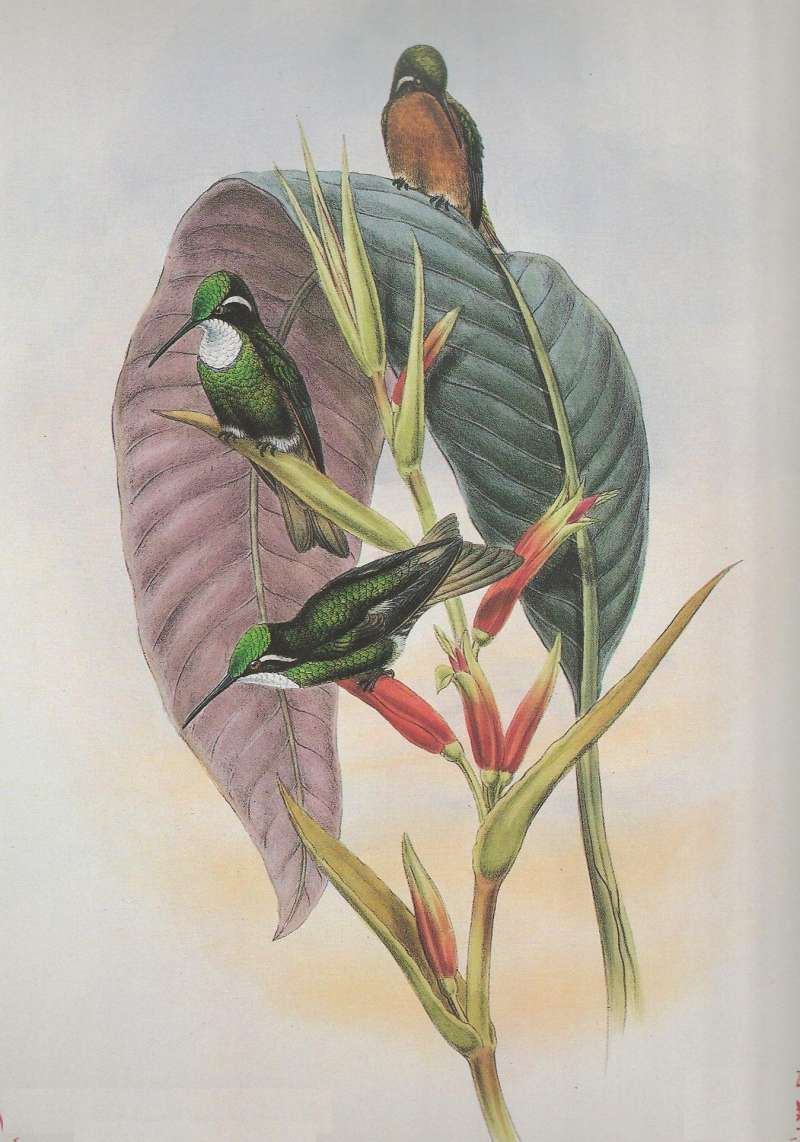
White throat mountain-gem (Oreopyra castaneoventris to Lampornis castaneoventris) is found per Garrigues from southern Costa Rica into western Panama. (Although his precise distribution map only shows Costa Rica, his text mentions Panama. Furthermore the scatter diagram of his map shows a range that would very likely not stop at the Panama border.) The male of this species can be recognized by the white throat, green upper breast, and pale lower breast, and even paler belly. The female of this species is difficult to separate from Lampornis calolaemus.
There are no subspecies mentioned in Clements 2007.
Garrigues notes this species is "fairly common" in the Talamanca highlands from 1,800 meters to the timberline.
There is confusion herein, which we can hopefully shed light on the contradictions, but not explain. There are evidently two closely related species each of which is each found in both Costa Rica and Panama. These life forms were not adequately separated as of 2003 in Howard and Moore. Howard and Moore shows Lampornis castaneoventris with two subspecies. The nominate subspecies was described by Gould in 1851, and the subspecies cinereicauda was described by Lawrence in 1867. However, they are both listed in Clements 2007 as full species: Gray tailed mountain-gem (Lampornis cinereicauda) and the white throated mountain-gem (Lampornis castaneoventris). Clements shows L. cinereicauda having an additional subspecies, subspecies homogenes.
It appears that the two John Gould drawings for these two species depict the same male bird! He has the tail perhaps correct, but not the lower breast. John Gould has a confusing entry in his notes for his plate #7 in his supplemental work. He names the gray tailed hummingbird (Oreopyra cinereicauda) in his plate 7. He also notes the white throated humming bird (Oreopyra leucaspis) for this plate but refers back to plate 264 which has seemingly become Lampornis castaneoventris.
Furthermore, in Garrigues in his excellent book on Costa Rica birds, he only mentions the white throated, but does not mention the gray tailed.The mountain-gem genus Lampornis is found from the southern United States south through much of Central America to Panama. There are 8 species. Most are about 4 inches (10 cm) in length. Most members are sexually dimorphic.
There is confusion between two of the species found in Costa Rica and Panama. The confusion is between Lampornis cinereicauda and Lampornis castaneoventris. (See discussion under L. castaneoventris.)
Fogden, Taylor, and Williamson counted 7 species by making L. cinereicauda a subspecies of L. castaneoventris.
We have arbitrarily separated herein a few species of hummingbirds based on their tails of males which include feathers that when spread give the outside feathers a longer length than the central tail feathers. These can be called scissor tailed or long tailed hummingbirds. We also have included herein some forked tail hummingbirds.
Since this feature can be found in several unrelated genera, this division is useful as an aid to identification, but not as an aid to cladistic taxonomy.
Hummingbirds (Family Trochilidae) are a family of 319 species of small birds that are well-known for their ability to hover. Prior to 1900, millions of these birds were exported from South America (primarily Colombia) and the Caribbean for use in jewelry in Europe and England. Many of the species are very brilliantly colored.
This family is nicely represented in Costa Rica where over 50 different species have been recorded.
Swifts and Hummingbirds (Order Apodiformes) are combined into a single order. Both families have excellent flying abilities. The swifts are known for their speed, and the hummingbirds for their ability to hover.
Clements in 2007 listed 100 swifts, 4 treeswifts, and 339 hummingbirds. (Total of 443 species.)
Aves contains about 8,650 different species of living birds known to science. Each year about one new species is discovered in some remote rain forest or remote island. In addition, scientists have been raising many subspecies to full species status which may raise the species count to 10,000. Birdlife recognizes 10,027 species as of 2011.
However, each year about one species goes extinct. The rate of extinction is increasing, and the rate of new discovery is decreasing, so that the number of bird species will soon begin to decline rapidly. Although different taxonomists would organize the birds differently, there are approximately twenty-seven orders of birds. These orders are broken down into about one hundred and fifty-five different families.
Recent research of the genetic structure of some of the shore birds and owls would indicate that the present organization of orders and families should have some modification.
The birds are a worldwide group of animals that are characterized by having the front limbs modified into wings that are used for flying. Perhaps the most unique feature of the birds is the feathers. These feathers are made up of a central support called a quill and a series of small filaments that are hooked together as barbs.
For many years it was believed that Archaeopteryx discovered in Bavaria was the oldest bird from about 150 million years ago. However, in l986, Sankar Chattterjee, a Texas paleontologist, reportedly discovered a bird in the genus Protoavis that lived about 225 million years ago.
When this project was begun in 1978, we used Austin & Singer for bird taxonomy. Since then, we have adopted many changes, but have kept some older concepts that are still found widely in the literature. Recently, we have used Clements and Howard & Moore. Very recently, we have used Monroe and Sibley for the higher taxonomy of the perching birds.
Backboned Animals (Phylum Chordata) are the most advanced group of animals on earth. These animals are characterized by having a spinal cord or backbone. Most members have a clearly defined brain that controls the organism through a spinal cord. Fish, amphibians, reptiles, birds, and mammals are in this phylum.
Currently, some taxonomists believe that the fish should be divided into two groups (sharks and regular fishes) and that there are some other primitive groups in the phylum such as hagfish or lampreys.
Animal Kingdom contains numerous organisms that feed on other animals or plants. Included in the animal kingdom are the lower marine invertebrates such as sponges and corals, the jointed legged animals such as insects and spiders, and the backboned animals such as fish, amphibians, reptiles, birds, and mammals.