SPECIES INFO
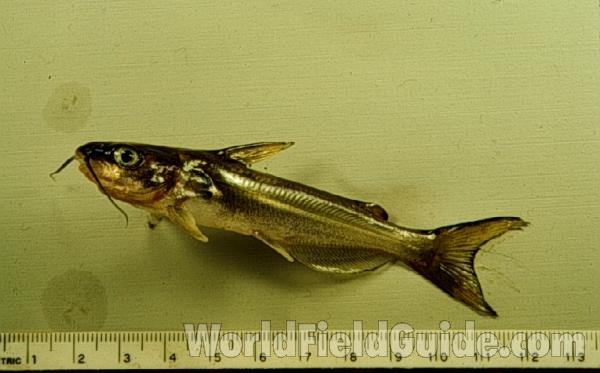
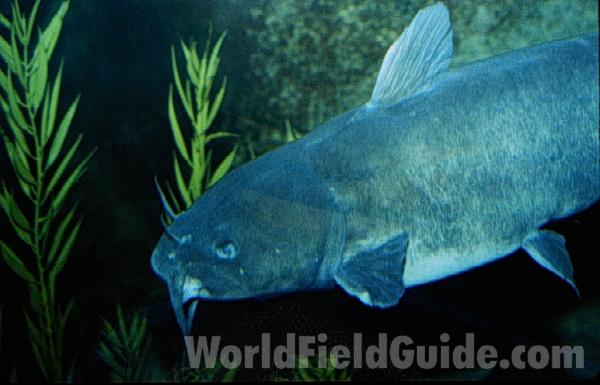
Channel Catfish, Ictalurus punctatus, is found in central North America from Canada to Florida. This species can be recognized by its forked tail and long narrow appearance. It is frequently considered a good sporting fish. Lengths of twenty to thirty inches are common and weights of twenty to thirty pounds have been reported.
Rohde etal in their book on the freshwater fish of the Virginia-Carolina area note that this fish is stocked and now established throughout their area and is now common in their area.
Pflieger in his 1975 book on Missouri fishes notes the channel cat is found almost everywhere in the state of Missouri. He notes this is a slender cat with a deeply forked tail. Pflieger notes the channel cat is the most abundant and widely distributed large catfish in the state.
The Siglers in their book on Utah fishes note that introduced populations are widely distributed in warmer lakes and reservoirs in Utah.
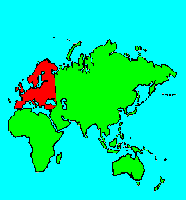
The channel cat has been introduced into Europe, and especially in Italy and Cyprus.Catfish genus (Ictalurus) originated in North America, and some of its species have been introduced in various places worldwide. The eyes are relatively large. Some members of this genus can become quite large. The channel catfish can be up to 50 inches. The blue catfish can be up to 65 inches.
North American Catfish group, Family Ictaluridae, is found in Canada, the United States, and Mexico. This group includes the bullheads, madtoms, and channel cats. Many of the species in this family have spines on their pectoral and dorsal fins that have poison tips. One should be most careful when handling any catfish as stings from these spines can be very painful. There are over 40 species found in North America and several more from Mexico and Guatemala. The madtoms (Genus Noturus) has approximately 25 species.
These fish are without scales and have 8 barbels. For example, Pflieger noted in his 1975 book on Missouri fishes that the state of Missouri contained 15 species from this family.
Catfish, Order Siluriformes, are found throughout the world. Although most of them are freshwater kinds, a few are found in a marine environment. They are characterized by having whiskers and barbels around their mouths. Many search for their food by smell and make little use of their small eyes.
Bony fish, Class Teleostomi, are a class of chordates that include the majority of fish-like animals found on earth. They are characterized by a bony jaw and a bony skeleton. They are found in both fresh and marine waters.
Backboned Animals (Phylum Chordata) are the most advanced group of animals on earth. These animals are characterized by having a spinal cord or backbone. Most members have a clearly defined brain that controls the organism through a spinal cord. Fish, amphibians, reptiles, birds, and mammals are in this phylum.
Currently, some taxonomists believe that the fish should be divided into two groups (sharks and regular fishes) and that there are some other primitive groups in the phylum such as hagfish or lampreys.
Animal Kingdom contains numerous organisms that feed on other animals or plants. Included in the animal kingdom are the lower marine invertebrates such as sponges and corals, the jointed legged animals such as insects and spiders, and the backboned animals such as fish, amphibians, reptiles, birds, and mammals.