SPECIES INFO
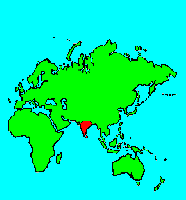
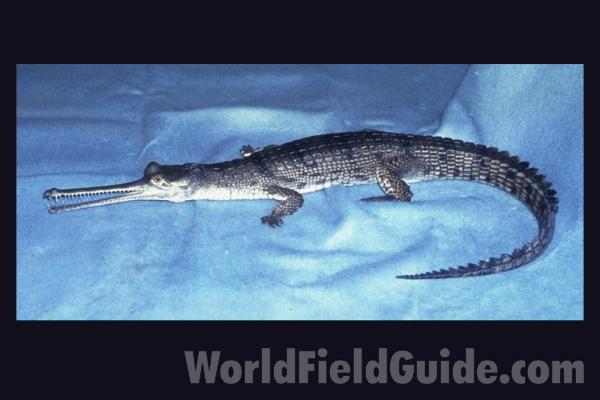
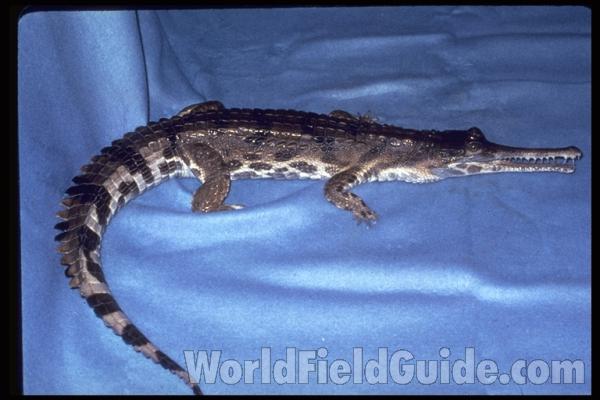
Gavial (Gavialis gangeticus) is found in northern India. This species is endangered but restocking efforts are in progress.Gavials (Family Gavialidae) are a large south Asian reptile that is related to and resembles the crocodile. They have a long narrow snout, and are primarily fish eaters. There is a single species in this family. However, modern researchers are moving the False Gharyal of Malaysia and Indonesia into this family. Thus there might be two species that belong here.
Alligator and Crocodile group (Order Loricata) is comprised of a small number of species of very large reptiles. They have very large mouths with razor-like teeth. Another characteristic is their very large tail that is used in swimming and as a tool to catch their prey. They all can raise themselves up on their legs and run very quickly. This group evolved in the time of the dinosaurs, but has some modern developments like a four chambered heart.
(Some taxonomists place all of the living members of this order into a single family, and then divide that family into three subfamilies. Here all of the living species have been placed into three families.) There are about 22 species in this group.
Reptiles (Class Reptilia) are an ancient group of scaled chordates. These scales may be permanently joined, as in the turtles, or flexible, as in the snakes. Reptiles are land-based. Their eggs are laid on land and the young are air breathing.
In the Great Big Book of Snakes and Reptiles published in 2014, they noted that there are more than 7,000 species of reptiles alive today.
Backboned Animals (Phylum Chordata) are the most advanced group of animals on earth. These animals are characterized by having a spinal cord or backbone. Most members have a clearly defined brain that controls the organism through a spinal cord. Fish, amphibians, reptiles, birds, and mammals are in this phylum.
Currently, some taxonomists believe that the fish should be divided into two groups (sharks and regular fishes) and that there are some other primitive groups in the phylum such as hagfish or lampreys.
Animal Kingdom contains numerous organisms that feed on other animals or plants. Included in the animal kingdom are the lower marine invertebrates such as sponges and corals, the jointed legged animals such as insects and spiders, and the backboned animals such as fish, amphibians, reptiles, birds, and mammals.