SPECIES INFO
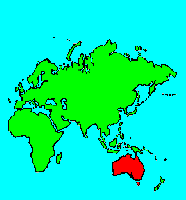
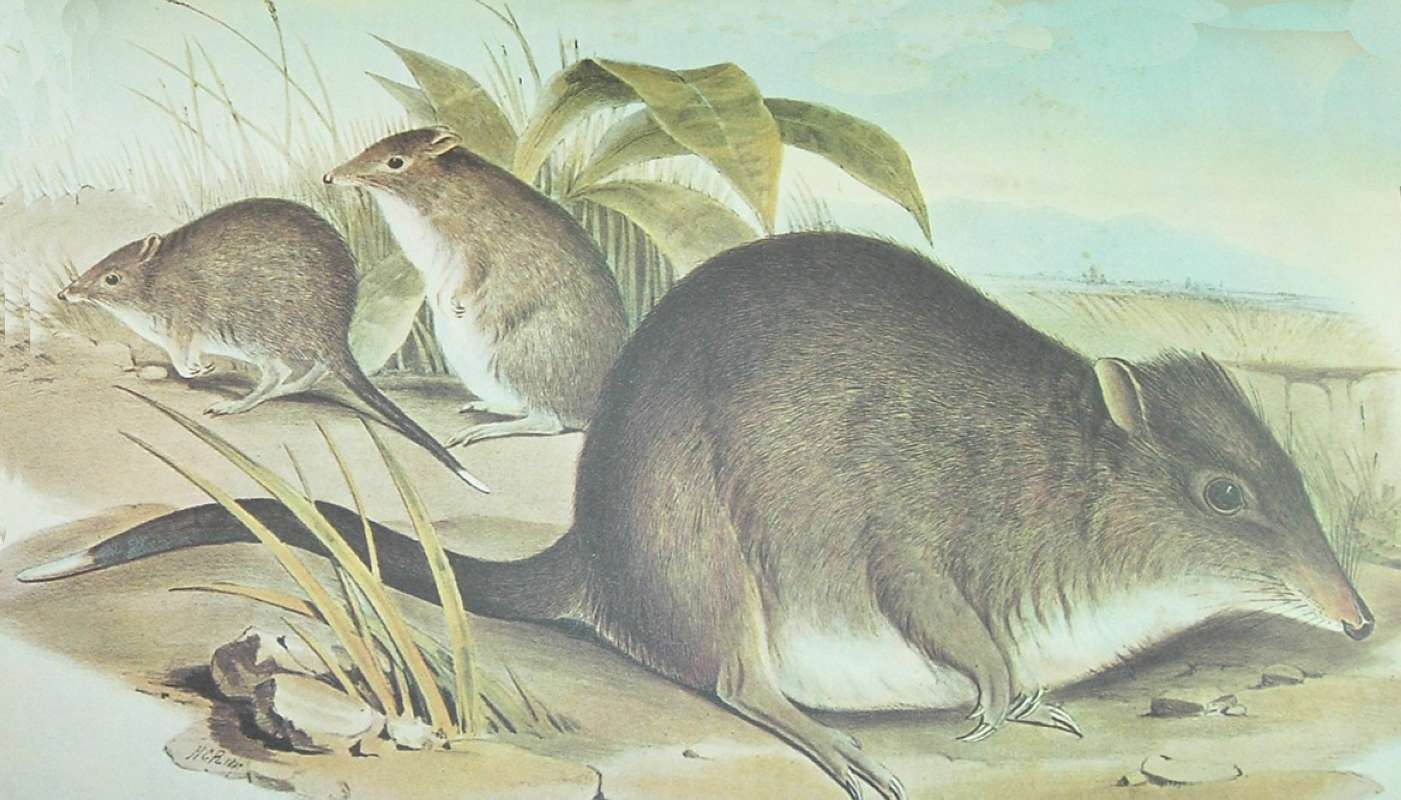
Long-nosed Potoroo (Potorous tridactylus) is found in a few limited disjoint coastal areas from southern Queensland south through New South Wales to Victoria and to Tasmania and nearby islands. This is also found in extreme SW Western Australia.
This species resembles rats and shrews and occupies in Australia the same ecological position as does the rodent in Europe. They have soft, pale, grayish fur on their stomachs. The tail is often tipped with white. The head and body length is about 14 inches with a tail of 8 to 10 inches. They prefer damp grasslands or wet forests but can be found in a variety of habitats. They feed primarily on some insects which they root out of the ground as well as plant roots, fungi and other vegetation.
There are two listed subspecies: The nominate subspecies is found on the mainland. The subspecies apicalis is found on Tasmania and adjacent islands.
Their populations have declined throughout Australia to the extent that they appear to be endangered, but some populations still appear common.The Potoridae family contains 4 genera with a total of about 10 species. The potoroos, bettongs, and musky rat kangaroo all belong here. This appears to be an ancient family that was perhaps the ancestor to the kangaroos and wallabies. These animals occupy a niche comparable to the rodents in Eurasia.
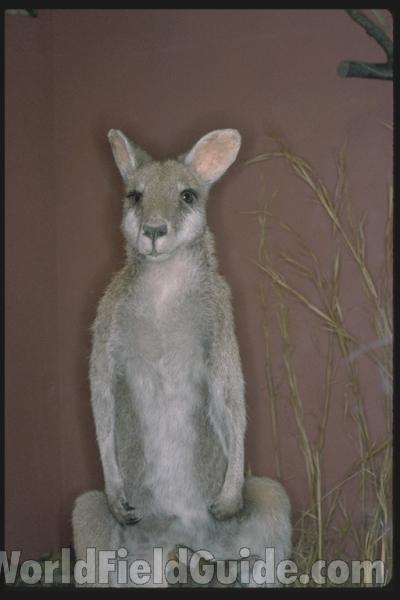
Kangaroos and Wallabies (Macropodidae Family) with over seventy species form a family that includes a range of species differing widely in appearance and habits. Some species are the size of rats; others may be as large as four feet tall. The marsupial pouch opens forward and is well-developed. There are five digits on the shorter forearms and usually no first digit on the hind limbs which can be relatively long. Members of this family may be found in Australia, New Guinea, Tasmania and surrounding islands.
Wallabia represents a group that differs from the kangaroo genus Macropus by its smaller size. Wallabies generally live on open plains where they can find shelter in shrubs or under trees while visiting the open areas only to graze late in the day or early mornings. Considered competitors of sheep and cattle, they are hunted and provide meat for dog food and some are considered excellent for the fur trade. They are an element of Australia's typical kangaroo community.
The potoroos, bettongs, and muskrat kangaroos also belong in this group.
We have used Wilson and Reeder, Mammal Species of the World, Third Edition, as a guide.
This large order of Australian and New Guinea region mammals was previously part of the marsupial group. However, these animals are so diverse and different they deserve their own order. This order contains 39 different genera and a total of about 143 species. The kangaroos, wallabies, koala and wombat all belong in this order.
We have used Wilson and Reeder, Mammal Species of the World, Third Edition, as a guide.
Mammals (Class Mammalia), together with the birds, are among the youngest of the classes of animals. In species count, mammals number about fifty-one hundred, trailing reptiles (approximately fifty-five hundred), fish (approximately eighteen thousand), and birds (approximately eighty-six hundred).
There are three sub-types of mammals:
monotremes, the most primitive:
Develop in reptilian-like eggs and suckle milk emerging
(i.e., spiny anteater, duckbilled platypus)
marsupials
Newborn emerges very underdeveloped and continue to
mature in a pouch on its mother's abdomen (i.e., opossums,
koala, kangaroo)
placental
Embryo develops within the uterus of the female and is
dependent on a placenta for nutrition and waste removal
(i.e., humans, lions, monkeys)
About sixty-five million years ago, the Tertiary era produced thirty-five orders of mammals. Of this number, eighteen have survived to represent Earth's most diversified as well as its most highly developed classification of animals.
Extinction of mammals is fast becoming a serious issue. Duff and Lawson present a list of forty-one extinct species that reached extinction prior to 1800. These forty-one species are not acknowledged in the counts of the various families. Duff and Lawson also present a list of forty-six species including three gazelles, one zebra, one seal, one deer, and one wolf that have probably gone extinct since 1800. These forty-six species are included in the family counts. Science is adding about forty to fifty new species a year to the list. Many of these are the result of divisions of prior species; some are recent discoveries.
Mammals owe their survival to adaptive capabilities that include the ability to exploit whatever sources of food are available to them, as well as their ability to adjust to various climes. Food specialization influenced evolution to such a great extent that the teeth structure can and has been used to provide extensive information on the food needs and various lifestyles of extinct species.
Despite the vast diversity among mammals in terms of size, habitats and adaptations, they share without exception many characteristics such as:
a. body hair
b. mammary glands
c. certain skull characteristics
d. four limbs that permit speed
e. parallel not perpendicular limbs
f. compartmentalized internal organs
g. a four-chambered heart and pulmonary circulation
Backboned Animals (Phylum Chordata) are the most advanced group of animals on earth. These animals are characterized by having a spinal cord or backbone. Most members have a clearly defined brain that controls the organism through a spinal cord. Fish, amphibians, reptiles, birds, and mammals are in this phylum.
Currently, some taxonomists believe that the fish should be divided into two groups (sharks and regular fishes) and that there are some other primitive groups in the phylum such as hagfish or lampreys.
Animal Kingdom contains numerous organisms that feed on other animals or plants. Included in the animal kingdom are the lower marine invertebrates such as sponges and corals, the jointed legged animals such as insects and spiders, and the backboned animals such as fish, amphibians, reptiles, birds, and mammals.